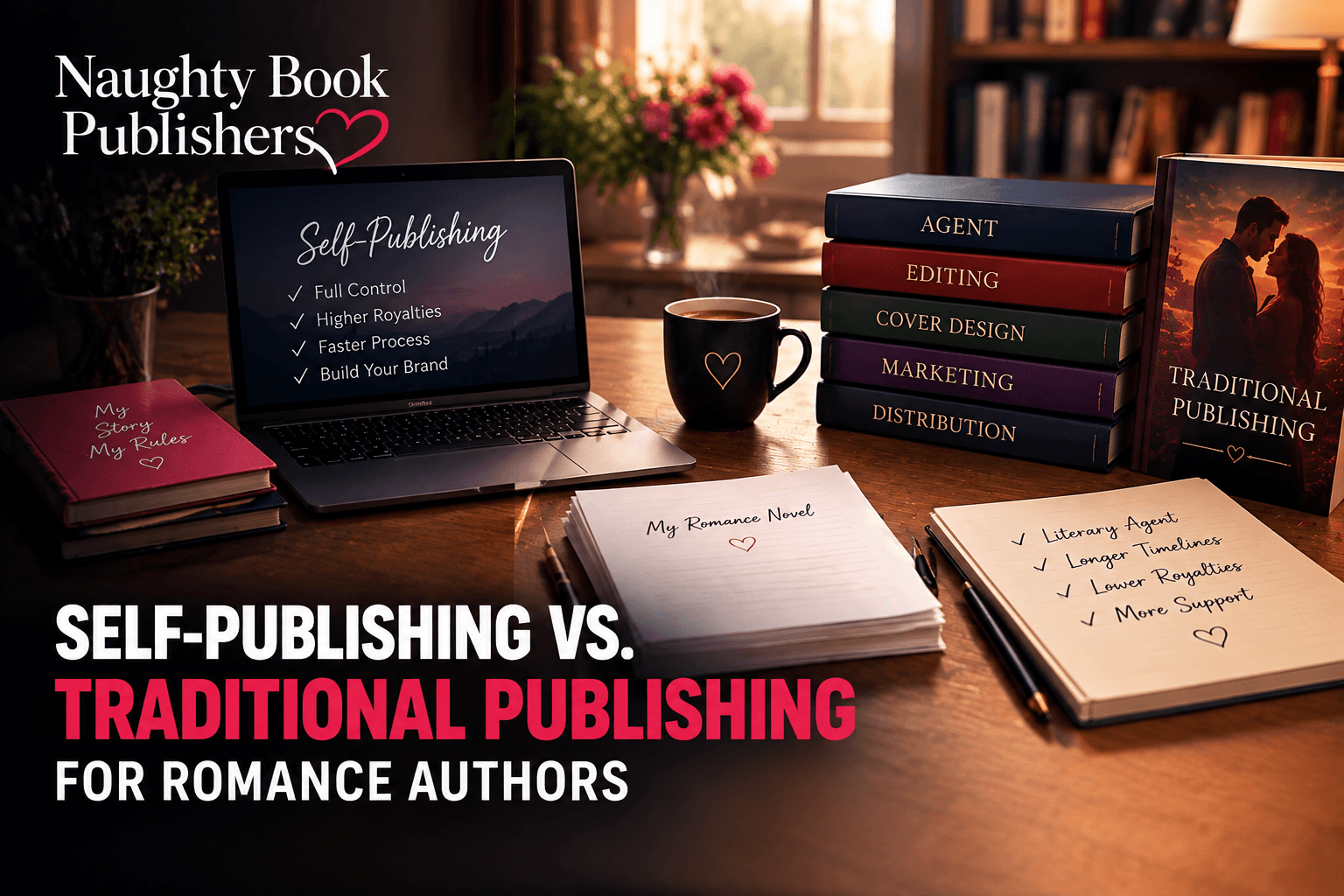
A romance novel can begin with nothing more than a story and a character that refuses to leave your mind. For authors, self-publishing vs. traditional publishing is not simply a choice between doing everything yourself and handing the book to a publisher.
The decision encompasses multiple aspects of a publishing process from costs, creative control to royalties, distribution, and promotional campaigns.
Self-publishing gives authors greater control and flexibility, while traditional publishing generally means lower direct production costs for the author but less control over the publishing process.
As Jane Austen wrote in Northanger Abbey,
The person, be it gentleman or lady, who has not pleasure in a good novel, must be intolerably stupid.
For an author, the goal is to choose a publishing route that helps the story reach the right readers.
Key Takeaways
- Self-publishing gives romance authors control over production, pricing, and publishing decisions.
- Traditional publishing generally covers the basic production expenses, but authors are less likely to have control over publishing decisions.
- It is entirely up to author to decide which is the right choice depending on their goals, expectations and resources.
- What a professional romance book needs is a strong editing & formatting, an eye-catching cover, and an exceptional marketing.
Difference Between Self-Publishing and Traditional Publishing
The biggest difference is who manages the publishing process and carries the production responsibilities. With self-publishing, the author takes responsibility from start to finish, preparing and releasing the book. This includes editing, cover design, formatting, ISBNs, pricing, and marketing.
With traditional publishing, a publisher generally manages core production services. The author isn’t required to pay for the services upfront. However, the difference is more than that.
✦ An Independent Romance House
Ready to Publish Your Romance Novel?
Let’s Bring Your Story to Life
Naughty Book Publishers helps romance authors polish, package, and publish fierce, unapologetic fiction — from manuscript to cover to release.
Authors have to rely for most of the process on the publishing company giving them an upper hand especially when it comes to creative control, and the workload.

Is Self-Publishing or Traditional Publishing More Affordable?
The word affordable can be misleading because the way both the models oversee the financial aspect is completely different. Self-publishing requires direct spending by the author. However, you decide which services you need and the professionals you want to hire.
Traditional publishing involves less direct upfront payment as the publisher handles those costs. In exchange, the author enters a contractual relationship and is less likely to have control over areas such as the cover, publishing schedule, pricing, and other publishing decisions.
Therefore, if your biggest concern is avoiding direct production expenses, traditional publishing may require less money upfront. If your priority is deciding exactly where your money goes, self-publishing offers more flexibility.
What Does Traditional Publishing Offer Romance Authors?
Traditional publishing reduces the amount of production work an author must manage. After a publisher accepts the manuscript, the publishing company generally handles major production stages.
This does not mean the author has no responsibilities. You still need to write, revise, communicate with the publishing team, review materials, and support your book when appropriate.
The major difference is that the publisher manages the production system rather than requiring you to organize and pay for every service independently. For authors who prefer professional publishing support without managing every production decision, traditional publishing is an attractive option.
The Dynamics of Royalties in Self-Publishing and Traditional Publishing
Royalties are one of the most important financial differences to understand. In traditional publishing, the contract explains how royalties are calculated and paid. Rates differ according to the format and the individual contract.
The Authors Guild notes that trade publishing contracts can use different royalty structures for hardcover, paperback, eBooks, and audiobooks. For example, eBook royalties in traditional contracts may be calculated as a percentage of publisher net receipts rather than the retail price.
That distinction matters. Self-publishing works differently because royalty calculations depend on the platform. For example, KDP currently provides different royalty structures for eBooks and print books.
For print books, the royalty calculation takes applicable printing costs into account. Do not assume that a percentage shown in a contract or platform description represents your final earnings.
Self-Publishing vs. Traditional Publishing: At a Glance
| Factor | Self-Publishing | Traditional Publishing |
| Upfront Production Spending | Usually Managed by Author | Generally Handled by Publisher |
| Creative Control | Higher | Usually Shared or Limited by Contract |
| Editing | Author Arranges it | Publisher Generally Manages it |
| Cover Design | Author Handles it | Publisher’s Responsibility |
| Formatting | Author Oversees it | Publisher Oversees it |
| Printing | Author Chooses Production Model | Publisher Manages Production |
| Marketing | Author Hires Support | Publisher May Provide Support |
| Publishing Schedule | More Flexible | Publisher Controls Schedule |
| Royalties | Platform-Dependent | Contract-Dependent |
The Ultimate Choice for Romance Authors
Your decision should be centered around your publishing goals. Ask yourself whether you want maximum control or greater publisher involvement. Consider how much money you are willing to invest.
✦ An Independent Romance House
Ready to Publish Your Romance Novel?
Let’s Bring Your Story to Life
Naughty Book Publishers helps romance authors polish, package, and publish fierce, unapologetic fiction — from manuscript to cover to release.
Also consider whether you want to build a long-term romance author brand. For example, an author with strong publishing knowledge, a clear visual identity, and the ability to manage professional services may prefer self-publishing.

Another author may value a publisher’s production structure, editorial team, and distribution support more than complete control. The question is not, “Which model is best?” It should be, “Which model fits this book and my goals?”
Real-World Scenarios for Romance Authors
Scenario 1: The Independent Contemporary Romance Author
An author has a polished 70,000-word contemporary romance. She understands formatting and has experience preparing digital books.
She hires professional cover support, publishes an eBook and paperback, and creates a focused launch plan. Self-publishing may work well because she can control the process while paying for the services she actually needs.
Scenario 2: The Romantasy Author Needing Intensive Support
Another author has an 85,000-word romantasy with structural problems. The manuscript needs substantial developmental editing, copyediting, professional cover design, print formatting, and stronger marketing support.
Self-publishing is still possible. However, the author needs a larger production budget and more professional assistance.
Scenario 3: The Author Seeking a Traditional Deal
A third author submits a manuscript to traditional publishers and receives an offer. Instead of directly paying for editing, design, printing, and distribution, the author enters a contract that defines rights, royalties, responsibilities, and any advance.
The financial arrangement is different because the publisher manages the production system.
Think Long and Hard
Do not choose a publishing model simply because a well-renowned romance author used it. Consider your manuscript first. A clean manuscript may need less editorial support than one with major structural problems. Think about your preferred formats.

Will you publish an eBook, paperback, hardcover, audiobook, or several formats?
Consider your marketing expectations. Publishing the book does not automatically create an audience. Also examine the agreement carefully if you work with a publisher or fee-based service.
Understand what you receive, what rights you grant, how royalties are calculated, and who is responsible for each publishing task. You can also explore Books & Success Stories for published romance titles and author outcomes.
Note: Self-Publishing Does Not Mean Doing Everything Alone
One common misunderstanding is that self-publishing means personally completing every task. It does not. You can hire professional editors, designers, formatters, and marketing specialists while retaining control over the publishing process. The only difference is that you are the one in charge for choosing and coordinating those services.
If you want professional support with your romance manuscript, explore Naughty Book Publishers’ romance publishing services.
Bonus Point: Think Beyond One Romance Novel
Your first book may become the beginning of a series. You may later release an audiobook, add another print format, enter a new romance subgenre, or increase your marketing investment.
Think beyond one launch. A publishing model that works for one book may not be the best fit for every future release. Building a repeatable process can make future publishing decisions easier.
FAQs
Is Self-Publishing Better Than Traditional Publishing for Romance Novels?
Not automatically. Self-publishing offers greater control and flexibility. Traditional publishing offers greater publisher involvement and generally lower direct production costs for the author.
The better option depends on your goals, resources, manuscript, and preferred level of control.
Do Traditional Publishers Charge Authors More to Publish a Romance Novel?
Traditional publishing usually does not cost the author more upfront than self-publishing. In traditional publishing, the publisher generally covers core production costs such as editing, cover design, formatting, printing, and distribution.
So, if you are comparing upfront costs, traditional publishing generally requires less direct spending from the author than self-publishing.
Which Publishing Option Gives Romance Authors Better Earning Potential?
Neither publishing model guarantees higher earnings. Self-publishing gives authors more control over pricing, platforms, and expenses. However, authors are responsible for production and marketing costs.
Traditional publishing usually covers the main production expenses, while the author earns royalties according to the publishing contract. Book sales, marketing, and the financial terms of your chosen publishing model are the primary factors in deciding your earning potential.
Disclaimer
Publishing costs, royalty structures, platform terms, and contractual arrangements can change.
Always verify current terms with the relevant publisher, platform, or official industry source before making a financial or contractual decision.
Publishing costs, royalty structures, platform terms, and contractual arrangements can change. Always verify current terms with the relevant publisher, platform, or official industry source before making a financial or contractual decision.
Conclusion: Which Publishing Path Is Right for Your Romance Novel?
Self-publishing vs. traditional publishing for romance authors is ultimately a decision about priorities. Self-publishing offers control, flexibility, and direct responsibility.
Traditional publishing generally offers greater publisher involvement and lower direct production spending for the author. None of these paths guarantee sales.
A strong romance novel still needs quality editing, an effective cover, clean formatting, appropriate distribution, and thoughtful marketing.
Choose the model that matches your manuscript, resources, publishing goals, and desired level of control. The right publishing path should not simply get your romance novel into the world. It should also help your career as an author grow.